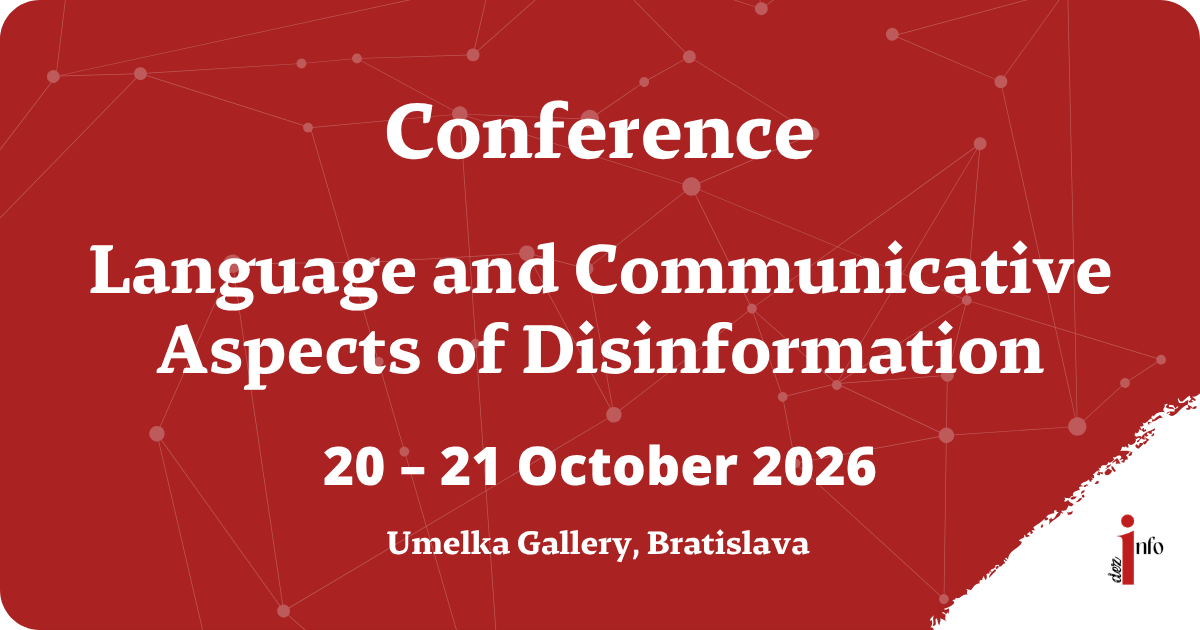
The V4 Conference on Pragmatic Aspects of Language and Latent Strategic Communication
21. 9. 2026 – 30. 11. 2026
Project Coordinator: Jaroslava Rusinková
Partner Institutions: Institute of Philosophy, Czech Academy of Sciences; University of Szeged; Faculty of Social and Economic Sciences, Comenius University Bratislava
Grant scheme and Evidence number: Visegrad Grant 22620468
Short description of the project
The project brings together experts across the V4 countries to facilitate the exchange of ideas/findings on the pragmatic aspects of language (mechanisms and principles) in the latent strategic communication. The main aim of the conference is to examine how this type of communication is reproduced through language in various public domains, particularly focusing on state strategic communication.
What is the main issue?
The project follows four years of research (APVV-22-0370) of the topic which was carried out by Ľ. Štúr Institution of Linguistics SAS. The process of information management in communication is complex phenomenon that plays a significant role in contemporary public discourse which is shaped by beliefs that we are living in a “post-factual” era (Peters – Rider – Hyvönen – Besley (eds. 2018), that there has been an unprecedented rise in information vulnerability (GLOBSEC 2021), that we live in an era of societal polarisation (DEKK 2025), or that linguistic meaning itself is becoming unstable. The public communication in the various types of media have become a central concern across numerous scientific disciplines. This project, realised in the form of an international conference, creates a space for academic exchange and critical reflection on these beliefs, with an emphasis on the role of language and communication. The conference is primarily oriented towards the V4 region, while also welcoming contributions from a broader international context.
What could be the solution?
From a linguistic perspective, discussion about information vulnerability cannot be oriented solely on content moderation or information management but must also address the communicative mechanisms that enable to distort various messages in order to be more persuasive and widely disseminated. The project contributes via 3 interrelated approaches. First, it advances research aimed at developing a model of effective state strategic communication with the public, grounded in clear, transparent, and accessible language. Second, the project supports the strenghtening of interpretive competence and communication culture. Third, it emphasises the role of language education in fostering critical thinking skills that enable individuals to critically evaluate various types of distorted communication. A central premise is that the effectiveness of such communication is grounded in the comprehensibility and interpretability of messages. The information manipulation succeeds because it relies on specific linguistic and communicative principles that create interpretive conditions conducive to misinterpretation. By identifying and analysing these mechanisms, the project seeks to make them visible and more easily contestable. The conference serves as a platform for disseminating research findings from the V4 region and for initiating structured interdisciplinary dialogue.
What is the conference's innovative element?
The project´s value lies in its integration of complementary perspectives that generate new insights into latent strategy communication research (Habermas 2011). First, the pragmatic approach grounds the research in linguistic pragmatics, focusing on how language is instrumentalised to achieve communicative aims. The information manipulation is thus not viewed simply as inaccurate or misleading content, but as a dynamic process that emerges and evolves through communicative practices. Second, the communicative approach recognises that distorted communication rarely reflects a single, isolated intention. Instead, it is embeded in broader social actions and relationships. Third, the interdisciplinary approach integrates research on V4 regional languages and discourses as they develop within specific social and linguistic contexts. The conference will present current linguistic and interdisciplinary findings, with the aim of gathering knowledge that can support the development of practical tools to mitigate the impact of latent types of strategic communication. Overall, the project highlights the crucial role of linguistic research in addressing wider societal challenges. Language functions not only as a means of communication, but also as a carrier of social relations and problems. By analysing communicative processes at the level of linguistic principles rather than surface content alone, the project advances understanding of the mechanisms underlying the distorted communication and its societal effects.

The project is co-financed by the Governments of Czechia, Hungary, Poland and Slovakia through Visegrad Grants from International Visegrad Fund. The mission of the fund is to advance ideas for sustainable regional cooperation in Central Europe.